Test And Tag Cost [QLD Price Guide For 2026]
In Queensland, test and tag total cost is around $2.50 to $9.50 per item (+GST), plus a minimum call-out charge of roughly $100 to $250. Bigger sites with hundreds of items tend to pay the lower rates, while small offices and shops often pay towards the top of the range, or just the minimum charge.
If you’ve been asked to “get the test and tag sorted” and you’re not sure what a fair price looks like, you’re not alone. Quotes can look completely different from one provider to the next. In this article, we’ll break down what test and tag really costs in Queensland, what drives the price up or down, and how often you actually need to book it.
Test And Tag Prices In Queensland For 2026
Test and tag costs are calculated based on two things: a set rate for each item tested, and a minimum charge to get a technician to your site. As a result, the more items you have, the less you’ll pay per item.
Here’s what you can typically expect to pay across Queensland in 2026:
| Service | Typical Cost In QLD (+GST) |
|---|---|
| Minimum call-out / service charge | $100–$250 |
| Test and tag (per item) | $2.50–$9.50 |
| RCD safety switch testing (per RCD) | $2.50–$9.50 |
| Extension lead or power board | $4–$8 each |
| Replacement plug fitted | $25–$55 each |
| Replacement lead fitted | $35–$75 each |
| Emergency and exit light testing | $8–$25 per fitting |
| After-hours or weekend testing | Plus 25–50% |
| Register and compliance report | Usually included |
Keep in mind that these are typical ranges, not quotes. Your final price depends on your site, your item count and what’s included.
Volume Pricing Tiers
Many providers use tiered pricing, where the per-item rate drops as your item count goes up. A typical Queensland example looks something like this:
| Number Of Items | Price Per Item (+GST) | Call-Out Fee |
|---|---|---|
| 1–100 | Around $5.00 | Around $90 |
| 101–500 | Around $4.70 | Around $90 |
| 500+ | Around $4.40 | Often waived |
| Number Of Items | Price Per Item (+GST) | Call-Out Fee |
|---|---|---|
| 1–100 | Around $5.00 | Around $90 |
| 101–500 | Around $4.70 | Around $90 |
| 500+ | Around $4.40 | Often waived |
In other words, a business with 600 items is usually paying a noticeably lower rate than a café with 20.
How Do Queensland Prices Compare To Other Cities?
Pretty closely, as it turns out. Test and tag pricing is fairly consistent in Australia, with WA tending to sit a little higher.
| City | Typical Cost Per Item (+GST) | Typical Minimum Charge |
|---|---|---|
| Brisbane | $3.00–$9.50 | $100–$250 |
| Gold Coast | $2.50–$9.50 | $100–$250 |
| Sunshine Coast | $2.30–$8.50 | Varies |
| Townsville | $2.50–$9.40 | Varies |
| Sydney | $3.00–$9.50 | $100–$250 |
| Melbourne | $3.00–$9.50 | $100–$250 |
| Perth | $4.50–$9.00 | $120–$260 |
How A Test And Tag Quote Is Built
Overall price will depend on:
- A per-item tagging rate for each appliance, lead or tool
- A minimum charge for the visit
- Extras such as repairs, regional travel or after-hours work
The register and compliance report are usually included in the price. However, it’s always worth checking, because some providers add a separate reporting fee.
Common Pricing Models
Not every provider prices the job the same way. Here are the models you’ll come across most often:
| Pricing Model | How It Works | Best Suited To |
|---|---|---|
| Per item | A set rate for every item tested | Sites with a known item count |
| Minimum charge | One fixed figure for the visit | Shops and small offices |
| Fixed site price | One figure based on an estimated count | Budgeting and tenders |
| Per item plus repairs | Testing rate, with repairs billed separately | Workshops and older equipment |
| Daily rate | Charged by time on site | Remote and regional sites |
| Schedule of rates | Agreed rates over a contract period | Multi-site businesses |
Why Is There A Minimum Charge?
The minimum charge covers the parts of the job that cost the same whether the technician tests 5 items or 50. That includes travel, parking, signing in, setting up the tester and preparing the report.
Most Queensland providers charge somewhere between $100 and $250 (+GST). The minimum usually includes the call-out, a set number of items, the test tags and your Certificate of Compliance.
Working Out Your Crossover Point
Here’s a handy trick. Divide the minimum charge by the per-item rate, and you’ll find the item count where you start paying more than the minimum.
For example, a $120 minimum at $6 per item covers 20 items. If you’ve only got 12 items, you’re paying for 20 either way. As such, it makes sense to round up anything else with a plug that’s due soon.
The good news is that combining nearby tenancies or branches into one visit spreads that minimum charge across more items.
What Affects The Cost Of Test And Tag?
The two biggest factors are how many items you have and where your site is. With that being said, a few key factors that can push a quote up or down.
1. Number Of Items
More items almost always means a lower average rate per item. Small sites are often quoted individually, because the minimum charge does most of the heavy lifting.
2. Location And Travel
Travel within a metro area is usually built into the rate. Regional sites often have travel charged separately, while remote sites may be quoted as a daily rate plus accommodation.
3. Number Of Sites
Each separate location may attract its own minimum charge. Three small sites booked separately can easily cost more than one larger site with the same total item count.
4. Type Of Equipment
Standard 240V appliances like kettles, monitors and phone chargers are quick to test. Three-phase equipment, RCDs and specialised items can need different test procedures, so they’re usually priced differently.
5. Access To Equipment
Items tucked behind desks, locked in storerooms or mounted up high take longer to reach. Sites that need inductions or special PPE (personal protective equipment) also add time to the job.
6. Timing
Weekend, early-morning and after-hours work typically adds a 25–50% loading. That covers the technician’s penalty rates rather than the testing itself.
7. Condition Of Your Equipment
Cracked plugs and frayed leads turn a testing visit into a repair job. The older and more heavily used your gear is, the more likely you’ll see repair costs on the invoice.
8. How Often You Need Testing
The more often your equipment has to be tested, the more visits you pay for each year. A construction site tested every three months is paying for four rounds a year, while a low-risk office might only need testing every few years.
How Much Will Test And Tag Cost For Your Business?
The easiest way to estimate your own cost is to multiply your item count by both ends of the per-item range. Then add your leads and power boards, and compare the total with the minimum charge.
Here are a few rough examples:
| Site | Approx. Items | Estimated Cost (+GST) |
|---|---|---|
| Small café | 18 | Minimum charge only ($100–$250) |
| Small office | 50 | $250–$475 |
| Medium office | 150 | $900–$1,350 |
| Workshop | 400 | $1,800–$2,600 |
| Site | Approx. Items | Estimated Cost (+GST) |
|---|---|---|
| Small café | 18 | Minimum charge only ($100–$250) |
| Small office | 50 | $250–$475 |
| Medium office | 150 | $900–$1,350 |
| Workshop | 400 | $1,800–$2,600 |
Keep in mind that these figures are before extras like repairs or after-hours loadings.
Leads And Power Boards Add Up
Extension leads and power boards are normally charged as individual items, at around $4 to $8 each. Thirty of them can add $120 to $240 to your bill.
They’re also the items most likely to be left out of a count – and the most likely to fail. If your office is running on a forest of power boards, installing a few extra power points goes a long way. It cuts your test and tag count and gets rid of a trip hazard at the same time.
Repairs Are Charged On Top
If an item fails, it’ll need repairing or replacing. As a general rule of thumb, a replacement plug costs around $25 to $55 and a replacement lead around $35 to $75, parts included.
However, it’s worth comparing the repair cost with the price of a new appliance. Spending $60 to fix a $30 desk fan doesn’t make much sense.
It should also be noted that in Queensland, it’s an offence to repair electrical equipment unless you hold the right electrical licence under the Electrical Safety Act 2002. Fixed-wiring faults found during testing also need a licensed electrician. This is where using an electrical contractor like Allec Electrical Solutions makes a real difference – faults can be fixed on the spot rather than waiting for a second visit.
What’s Included In A Test And Tag Service?
A proper test and tag service is a lot more than slapping a sticker on a cord. It’s carried out to the Australian Standard AS/NZS 3760:2022 (In-service safety inspection and testing of electrical equipment) and typically includes:
- A visual inspection of cords, plugs and casings for damage or wear
- Electrical testing with a calibrated portable appliance tester
- A pass or fail tag showing the test date, the next due date and who tested it
- A register listing every item and its result
- A Certificate of Compliance
- A reminder when your next test is due
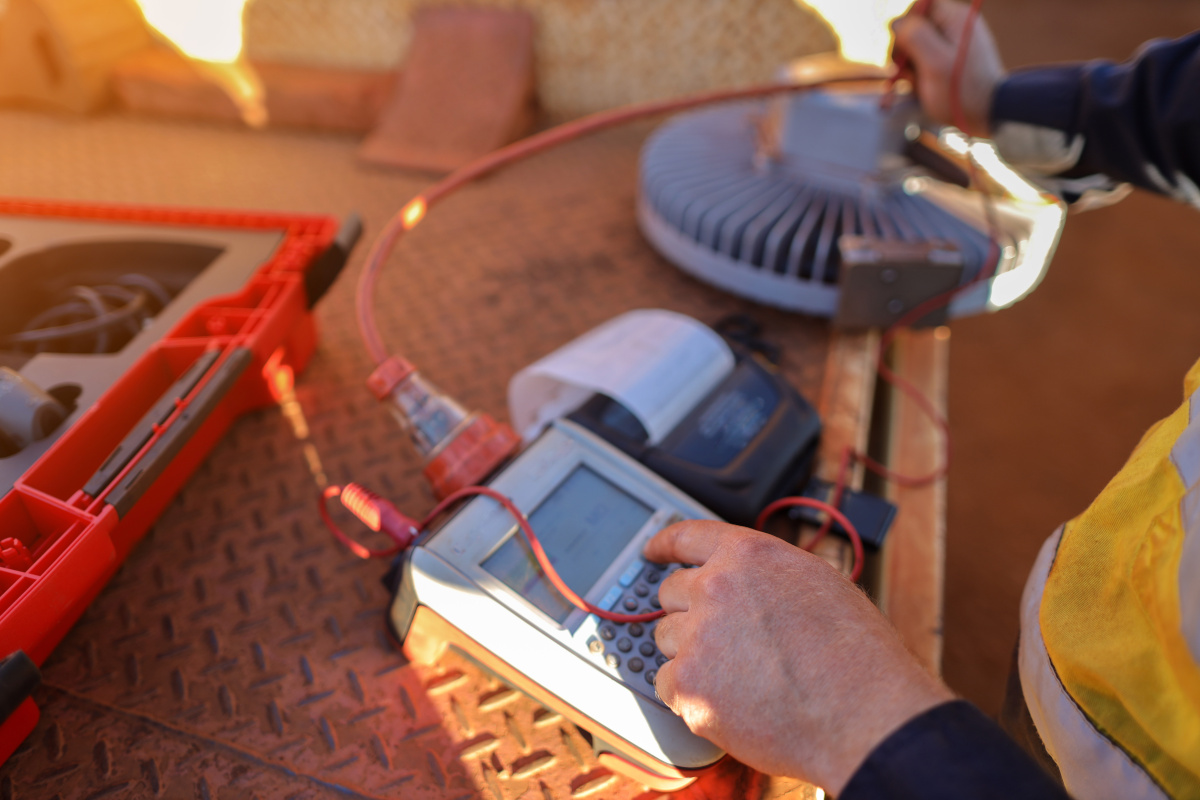
A portable appliance tester (often called a PAT) is the device that checks things like earth continuity and insulation resistance. In plain terms, it confirms the appliance won’t give someone a shock or cause a fire if something goes wrong inside it.
Any item that fails is tagged as failed, listed in your report and taken out of use straight away. From there, it needs to be repaired or replaced before anyone uses it again.
Bundling Other Tests Into One Visit
You can often add RCD testing and emergency and exit light testing to the same visit. Since you’re only paying one call-out, bundling usually works out cheaper than booking each service separately.
How Often Do You Need To Test And Tag In Queensland?
In Queensland, employers must regularly inspect and test specified electrical equipment and safety switches under the Electrical Safety Regulation 2013. Specified electrical equipment is generally anything rated at 20 amps or less, which covers most of the plug-in gear in a typical workplace.
How often you need to test depends on the type of work you do. Here are the maximum intervals set out by WorkSafe Queensland:
| Type Of Work | Maximum Testing Interval |
|---|---|
| Construction work: portable tools and other equipment | 3 months |
| Construction work: transportable structures and construction wiring | 6 months |
| Manufacturing work: not double insulated | 6 months |
| Manufacturing work: double insulated | 12 months |
| Amusement work: not double insulated | 6 months |
| Amusement work: double insulated | 12 months |
| Service work (no safety switch fitted) | 12 months |
| Office work (no safety switch fitted) | 5 years |
Double insulated equipment has an extra layer of insulation, so it doesn’t rely on an earth wire to keep you safe. You’ll usually spot it by the “square within a square” symbol on the label.
How Safety Switches Can Lower Your Test And Tag Costs
Here’s something a lot of business owners don’t realise. In Queensland, the office and service work intervals above only apply where no safety switch is fitted.
In other words, if your office or service business is properly protected by safety switches, your test and tag obligations can drop significantly. Keep in mind that the safety switches themselves still need regular testing, so it doesn’t remove the job entirely. However, for many small businesses, it’s a one-off upgrade that pays for itself over a few rounds of testing.
If you’re not sure whether your switchboard has the right protection, a licensed electrician can check it for you.

Safety Switch Testing Intervals
Safety switches (also called RCDs, or residual current devices) need their own testing. There’s a simple push-button test you can usually do yourself, plus a more detailed timed test done by a competent person.
| Type Of Work | Fixed: Push-Button Test | Fixed: Timed Test | Portable: Push-Button Test | Portable: Timed Test |
|---|---|---|---|---|
| Construction | 1 month | 12 months | Daily or before each use | 3 months |
| Manufacturing | 6 months | 12 months | Daily or before each use | 12 months |
| Office | 6 months | 2 years | 3 months | 2 years |
| Amusement | 6 months | 12 months | 3 months | 12 months |
| Service: commercial cleaning | N/A | N/A | Daily or before each use | 6 months |
| Service: other | 6 months | 2 years | 6 months | 2 years |
Who Can Test And Tag In Queensland?
Only a person appointed as competent by their employer can test and tag electrical equipment. Competence can come from training, qualifications, experience or a mix of all three.
According to WorkSafe Queensland, a competent person needs to be able to:
- Visually inspect equipment to AS/NZS 3760
- Tell double insulated and earthed equipment apart and test each correctly
- Carry out earth continuity and insulation resistance tests
- Test safety switches
- Use the tester properly and interpret the results
- Understand how the Electrical Safety Regulation applies to the workplace
The nationally recognised training unit is UEERL0003 (Conduct in-service safety testing of electrical cord connected equipment and cord assemblies).
Is It Cheaper To Do Your Own Test And Tag?
A lot of business owners think, ‘how hard can it be? We’ll just buy a tester and do it ourselves.’ The truth is, once you add everything up, in-house testing rarely works out cheaper for small and medium businesses.
Here’s what’s involved:
- A basic appliance tester starts at around $800, while logging testers with tag printers run around $2,250 to $4,200
- Ongoing calibration of the tester
- Test tag prices sit at roughly $29 per 100
- Training for at least one staff member
- Staff time pulled away from their actual job
- Keeping compliant records and reminders
- Calling a local electrician anyway for any repairs
If you’ve got thousands of items across multiple sites, in-house testing can make sense. However, for most businesses, a professional service is the more cost-effective and lower-risk option.

Ways To Reduce The Cost
The good news is that a little preparation makes a big difference to your final bill. Here’s what we recommend:
- Count your items before you ask for a quote, broken down by category
- Include monitors, chargers, fridges, urns, heaters and tools in vehicles
- Send your previous register if you have one
- Gather items together and unlock storerooms before the technician arrives
- Book within normal trading hours where you can
- Bundle RCD and exit light testing into the same visit
- Put multiple sites on one schedule with one renewal date
- Install extra power points to cut down on power boards
- Consider safety switches if you run an office or service business
Fixed Price Or Per Item?
A fixed price gives you budget certainty, but it usually includes a buffer. To compare it fairly, divide the fixed price by your item count.
For example, $1,200 for 150 items works out to $8 per item. If that’s well above the per-item quotes you’re seeing, you’re paying a premium for the certainty.
Common Mistakes When Comparing Test And Tag Pricing
Mistake #1: Comparing Per-Item Rates Alone
A low per-item rate looks great on paper. However, it doesn’t tell the whole story if the minimum charge is high or the register costs extra. Always compare the total price based on your actual item count.
Mistake #2: Forgetting Leads And Power Boards
Leads and boards are easy to overlook when you’re counting, but they’re charged as items. Leaving them out of your count means your quote won’t match your invoice.
Mistake #3: Booking Each Site Separately
Every separate booking request can mean another minimum charge. Putting all your sites on one schedule cuts travel and admin costs, and the rate can be based on your combined item count.
Mistake #4: Choosing A Quote With No Item Count
A quote that isn’t based on a real item count is really just a guess. If the price seems well below the usual range, it may exclude things you’ll end up paying for later.
Need Test And Tag In Queensland? Allec Electrical Solutions Can Help
Don’t wait until an audit, an insurance claim or a workplace incident to find out your equipment is overdue.
Test and tag costs in Queensland typically sit between $2.50 and $9.50 per item, plus a minimum charge of around $100 to $250. Your final price comes down to your item count, location, access, timing and how often your type of work needs testing. Getting a written, itemised quote based on your actual count is the best way to know exactly what you’re paying for.
As licensed electricians, Allec Electrical Solutions can test and tag your equipment, fix faulty plugs and leads on the spot, and install safety switches to help reduce your ongoing compliance costs. Get in touch with our team today for a fast, no-obligation quote.

FAQ
How Much Does Test And Tag Cost Per Item In Queensland?
Most Queensland providers charge around $2.50 to $9.50 per item (+GST). Larger sites usually pay towards the lower end, while small offices and shops pay towards the higher end.
Is Test And Tag A Legal Requirement In Queensland?
Yes, for many workplaces. The Electrical Safety Regulation 2013 requires employers to regularly inspect and test specified electrical equipment and safety switches, with intervals that depend on the type of work.
Can Any Electrician Do Test And Tag?
Licensed electricians generally have the skills to test and tag, but the legal requirement is competency to AS/NZS 3760. The big advantage of using an electrician is that any faults can be legally repaired straight away.
Who Pays For Test And Tag In A Rented Office Or Shop?
In most cases, the business using the equipment is responsible for testing it, not the landlord. However, it’s worth checking your lease, as the landlord is usually responsible for fixed wiring and any safety switches on the switchboard.